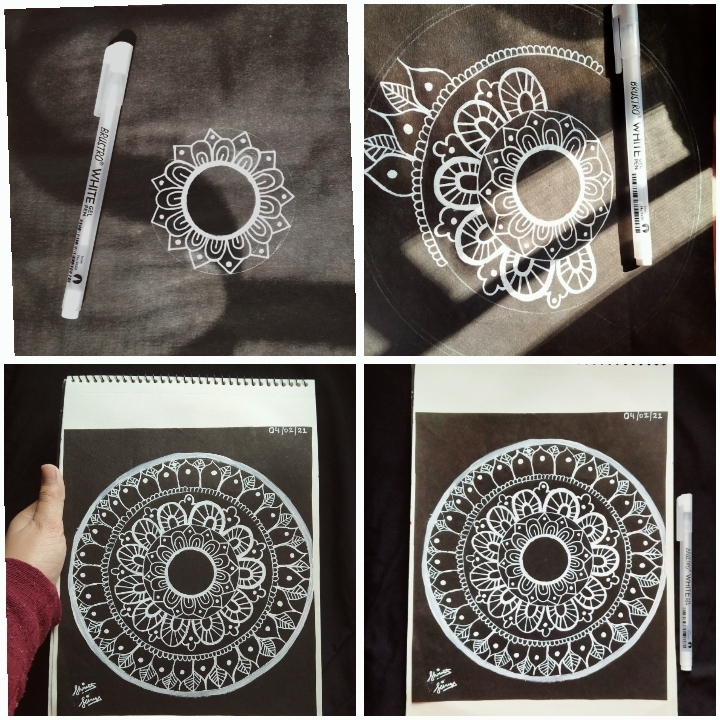

White Mandala on black paper. This my first Mandala on black paper by using white gel pens. This looks so beautiful and very easy to draw. You must have try this idea, this is so simple and satisfying.
Hope you like this Mandala!!😊
Adding Creativity Through Brush………..

White Mandala on black paper. This my first Mandala on black paper by using white gel pens. This looks so beautiful and very easy to draw. You must have try this idea, this is so simple and satisfying.
Hope you like this Mandala!!😊
I Just Love "Adding Creativity Through Brush" For Me Art Is Not Paint It Is Love... View more posts

 Shristy Singh
Wow!
LikeLiked by 8 people
Thank you!!
LikeLiked by 3 people
Beautiful ❤️ mandala
LikeLiked by 8 people
Thank you
LikeLiked by 3 people
Nice! ❤️
LikeLiked by 9 people
Thank you!!
LikeLiked by 2 people
Beautiful!
LikeLiked by 7 people
Thank you!!
LikeLiked by 2 people
Beautiful art!!!
Do visit my site and follow it 🙂
Thanks!!
LikeLiked by 5 people
Thanks Ananya!!
I have allready visited to your blog and followed it.
LikeLiked by 1 person
Beautiful 💖💖
LikeLiked by 6 people
Thank you so much 🙂
LikeLiked by 3 people
🖤💟
LikeLiked by 4 people
😊😄
LikeLiked by 2 people
Pretty!
LikeLiked by 3 people
Thank you
LikeLiked by 2 people
So beautifully done! I am so glad you are sharing your artwork, Shristy.
LikeLiked by 4 people
Thank you so much!!
LikeLike
Beautiful!
LikeLiked by 5 people
Thank you!!
LikeLiked by 4 people
Welcome!
LikeLiked by 3 people
😊
LikeLiked by 2 people
beautiful
LikeLiked by 5 people
Thank you
LikeLiked by 2 people
Beautiful.
LikeLiked by 5 people
Thank you
LikeLiked by 2 people
Beautiful piece of art! 😍
LikeLiked by 3 people
Thank you so much!!
LikeLiked by 2 people
You’re welcome 😀
LikeLiked by 3 people
🙂😊
LikeLiked by 2 people
Beautiful it is..I too love White mandala on black paper
LikeLiked by 3 people
Thank you so much 🙂
LikeLiked by 2 people
Great job. How long did this take?
LikeLiked by 3 people
Thank you so much 😊. One to two hours.
LikeLiked by 2 people
It must be a fun and peaceful two hours. 😊
LikeLiked by 3 people
Yes! 😊
LikeLiked by 2 people
That’s a good thing.😊
LikeLiked by 3 people
Ya!🙂
LikeLiked by 2 people
😊
LikeLiked by 3 people
how beautiful!
LikeLiked by 4 people
Thank you!!
LikeLiked by 2 people
Awesome art
LikeLiked by 4 people
Thank you!!
LikeLiked by 2 people
Very Nice Shrishty!!
LikeLiked by 3 people
Thank you so much Ananya 😊
LikeLiked by 1 person
Lovely! You’re talented.
LikeLiked by 4 people
Thank you so much 🙂
LikeLiked by 2 people
You’re most welcome.😀
LikeLiked by 3 people
😀
LikeLiked by 2 people
Pretty!!❤️
LikeLiked by 5 people
Thank you!!
LikeLiked by 2 people
This is very pretty Shristy, looks like lace!
LikeLiked by 3 people
Glad you liked it , thanks 😊.
LikeLiked by 3 people
Nice !!
LikeLiked by 2 people
Thanks!!
LikeLiked by 1 person
Wow. You’re really good!
LikeLiked by 3 people
Thank you so much 😊❤️
LikeLiked by 1 person
It’s so pretty! Lovely artwork.
LikeLiked by 3 people
Thank you so much 🙂
LikeLiked by 1 person
Absolutely beautiful, you must have the patience of a Saint to achieve such a delicate and intricate piece of art.
LikeLiked by 3 people
Glad you liked it thanks!!
LikeLiked by 1 person
Beautiful Mandela art!!! Love all the details!
LikeLiked by 3 people
Thank you so much 🙂
LikeLiked by 1 person
Beautiful!😃❤️
LikeLiked by 2 people
Thank you so much 🙂
LikeLiked by 1 person
This is exceptional.
LikeLiked by 2 people
I am so glad that you like it , thank you so much 😊❤️.
LikeLiked by 1 person
Beautiful detail! You are very talented and must have a lot of patience. Thank you for following my blog.
LikeLiked by 3 people
Thank you so much for, your kind words.And thanks for following my blog too.🙂
LikeLike
Brilliant!❤
LikeLiked by 2 people
Thanks (:
LikeLiked by 1 person
This is so beautiful!😍🌟
LikeLiked by 1 person
Thank you so much 🙂
LikeLiked by 1 person
Lovely!
LikeLiked by 1 person
Thanks!
LikeLike
So pretty…. Talent doesn’t discriminate between colours😉!! This black and white one is wonderful!!🧡
LikeLiked by 1 person
I am so glad that you like it, thank you so much!!🧡
And thanks for following too!!
LikeLiked by 1 person
Wonderful
LikeLiked by 1 person
Thank you
LikeLiked by 1 person
Hi your blog I follow.
LikeLiked by 1 person
Hello there, thanks for visiting and following….
LikeLiked by 1 person
Positive Time Oriented Commandments: The Rif halachic commentary to ראש השנה
As the blowing of the shofar on Yom HaDin upon the Brit employs 3 basic notes: takeah, truah, and sha’varim, in like as similar manner the תרי”ג commandments have 3 fundamental branches: positive, negative, and positive time oriented commandments. My chief criticism of Talmudic scholarship made by the era of Reshonim, which includes the Zohar, their abysmal failure to address how the Talmud transmutes rabbinic halachot unto positive time oriented Torah Commandments, carried out through the mitzva of tefilla.
Remember my first year in Yeshiva, when I requested a shiur on the Siddur and the inability of those rabbis and Torah educated members of the Shul to explain the 42 letter Divine Name and other basic fundamentals with any rational comprehension of “Why”? The mystic chassidic works on the Siddur speak in the language of gobbledygook, which compares to me speaking the language of dog – it evokes laughter, but not respect from my family.
Then came Rabbi Aaron Nemuraskii, he integrated Talmudic scholarship as the basis by which to interpret the k’vanna of the positive time oriented Siddur. Repeatedly he emphasized to me, just as the Gemara stives to interpret the k’vanna of the Mishna, post sealing of the Sha’s Bavli scholarship should study the Talmud to interpret the k’vanna of the Shemone Esrei, the kre’a shma, the relationship between Hallel to the Pesukei dezimra, the inverse order of the Shabbat Musaf tefilla compared to the distinction in k’vanna between saying the kre’a shma in the morning to the evening – learned in turn, from acceptance of the blessings and curses of the Torah. Rabbi Nemuraskii repeated over and again: mitzvot learn from other mitzvot, like metal sharpens metal.
The Reshon p’shat schools, other than Rashi’s Chumash commentary, tends to isolate subjects rather than integrate their p’shat specific subjects to a comprehensive Big Picture idea. Rav Aaron by sharp contrast he stood Yiddishkeit upon two legs: Bavli & Siddur. Scholarship which failed to unify Talmudic wisdom together with Siddur k’vanna, Rav Aaron questioned the validity of any such “scholarship/research”. Avodat HaShem: first and foremost, accomplished through the mitzva דאורייתא of tefilla. As the commandment of the Red Heifer limits korbanot avodat HaShem, in like and similar vein, tefilla demands the dedication of tohor middot. Rav Aaron did not cry over spilled milk. We don’t have the ashes of the Red Heifer, therefore we all live our lives condemned to tuma. Bunk, complete and utter narishkeit; a losers’ excuse as to why he lost the game!
Postive time oriented commandments require the dedication unto HaShem of Torah and Talmudic defined tohor middot. Tefilla as a Torah commandment does not depend upon sacred wood and stone in order to worship God. By the terms of the brit faith, the Spirit of HaShem (think blowing the Shofar) lives within our hearts. Transmuting Talmudic halachot as the definition of a given Mishna; affixing that given Mishna to a designated blessing within the Shemone Esrei kabbala, defines the substance and heart of all Talmudic scholarship from Rabbi Akiva to the present day!
Halachic debates over p’sok halacha, it compares to the frumkeit: up turned nose of holier than thou. Unlike the opinion of Descartes philosophy, the heart and soul of all Yiddishkeit hinges upon the k’vanna of the dedication of tohor middot through the mitzva of tefilla. HaShem. We call to judge the k’vanna of our heartfelt dedications: like as happened in the story of Cain and Abel. If thereafter we happen by chance to accomplish and keep physical halachot – Yofee. But halachic observance of mitzvot, far from the main event in Torah faith. If a Jew presented an external picture of being totally secular, barring murder or making public desecration of the Torah … but in tefilla that “secular Jew” dedicated tohor positive time oriented halachic determinations of the k’vanna of a specific Mishna, joined with Aggadic or Midrashic p’shat of prophetic mussar, then that Jew qualifies as a very righteous Torah observant Yid – no body the wiser other than HaShem alone.
Not the ritual observance of halachot which makes a Jew faithful and righteous. Rather the dedication of tohor – Torah NaCH Talmud and Midrash defined middot – unto HaShem as a Duty of the Heart wherein HaShem judges the faith of all Yidden on Yom HaDin upon the Brit. Contrast this judgment of all Yiddishkeit with this informative piece of modern scholarship:
https://jewishencyclopedia.com/articles/15278-zohar
ZOHAR (called also in the earlier literature Midrash ha-Zohar and Midrash de-Rabbi Shim’on ben Yoḥai):
By: Joseph Jacobs, Isaac Broydé
LikeLike
You are an amazing artist😍
LikeLiked by 1 person
Thank you so much.
LikeLike
Great – Mandala art is cool!😃you are talented.
LikeLiked by 1 person
Thank you so much..
LikeLiked by 1 person