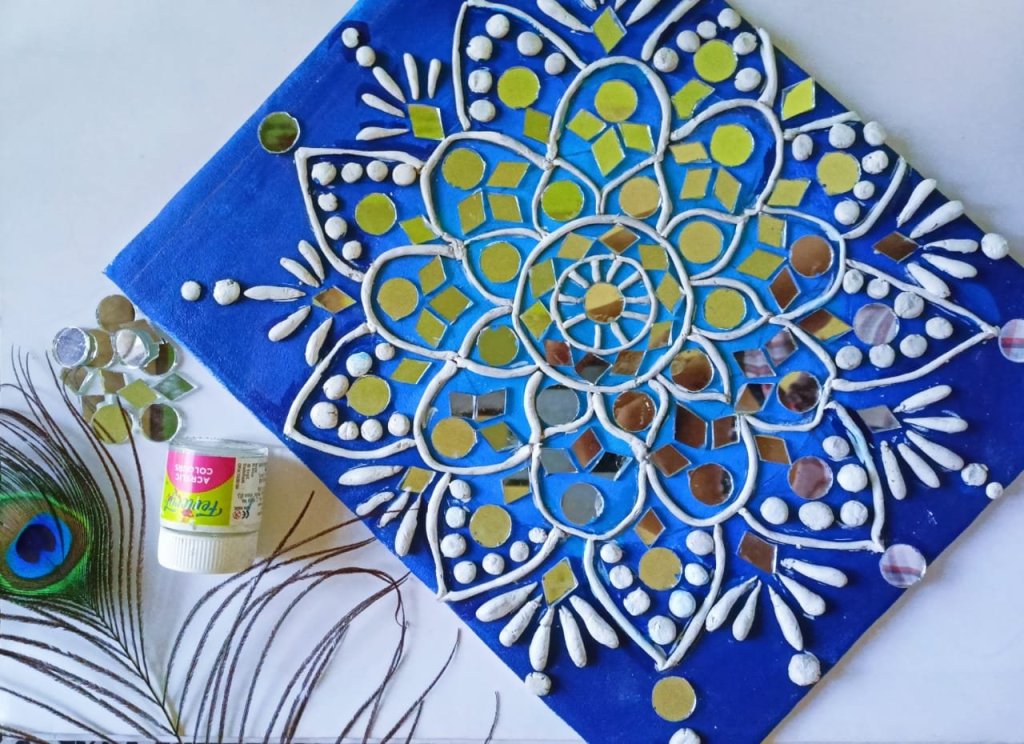
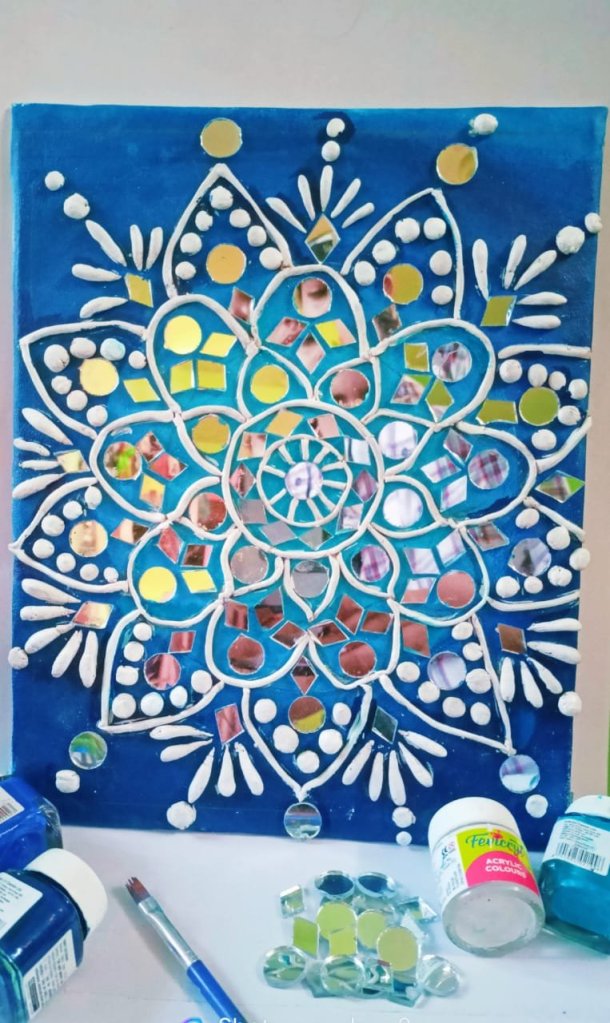
Hello everyone! Hope you all are doing good! Today I have first ever tried ‘Lippan Art’, this art form is little bit harder then the other ones. As you all know that I love making different types of art forms. Firstly know a little bit about this art form.
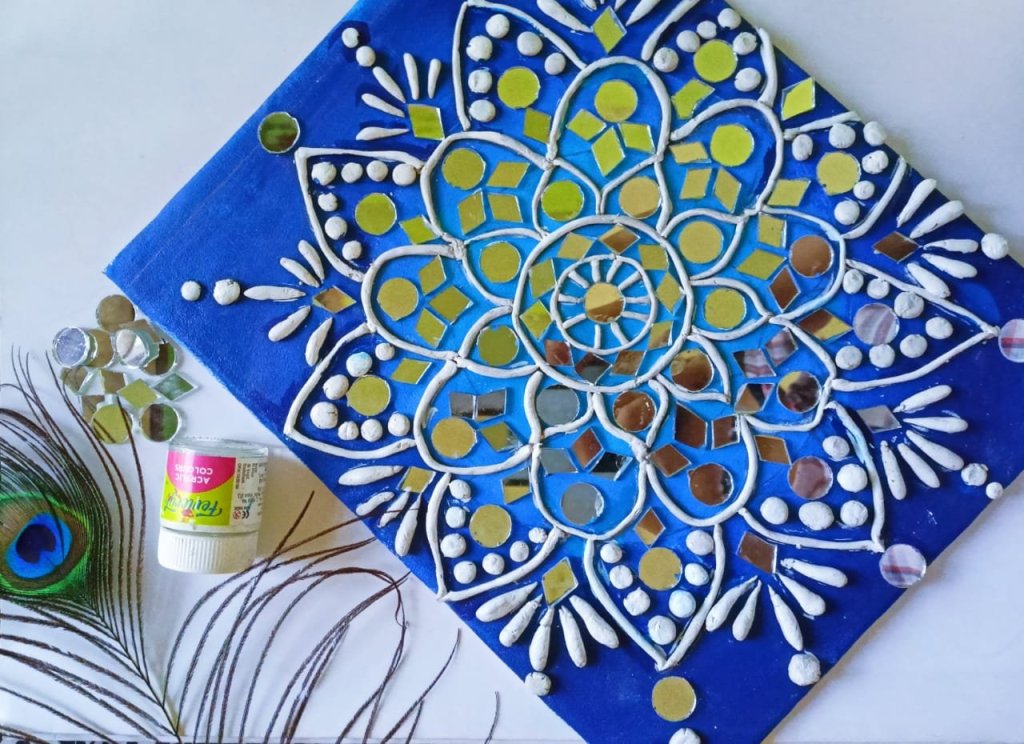
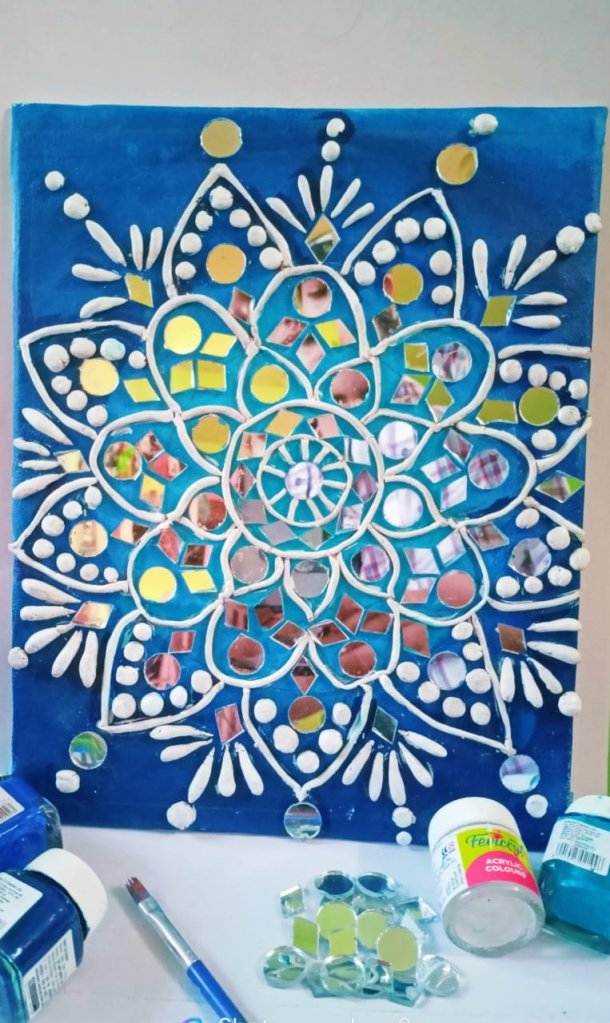
What is ‘Lippan Art Work’?
. Lippan work is a traditional art form western India and is mainly done by women of the Rabri community of Kutch, Gujrat. This mud relief work is done on inside of mud walls using clay.
How to make this painting?
1. First you need a canvas and paint its base by using white acrylic colour. For easy blending.
For blending colours I have used flat brush no. 12
Canvas size: 21cm× 28cm
2. Start making patterns of your choice with a pencil.
3. Then start blending colours from middle of the canvas light to dark colour.
Shades of Acrylic Colours I have used.
I am using Camlin Acrylic Colours .
. 239 -Light blue.
. 430- Ultramarine blue
. 351- Prussian blue
. 478 – White
4. Let it dry your colours first at least for full night.
5. When your colours are dry then start making patterns with clay of your choice.
6. Let it dry your clay for 1 to 2 days.
7. Then stick mirrors of your choice of shapes.
. I have used two shapes of mirrors.
Link of this product’s
Shilpkar clay: https://www.amazon.in/dp/B07HRV1YZW/ref=cm_sw_r_apan_glt_fabc_8W1KD24QYDYF6X5SM8CC
Acrylic Colours: https://www.amazon.in/dp/B07N2577XM/ref=cm_sw_r_apan_glt_fabc_3Q26BWXBYGXVRX9A4BGD?_encoding=UTF8&psc=1
Flat brush set: https://www.amazon.in/dp/B078FYHMTW/ref=cm_sw_r_apan_glt_fabc_X7WBE96B8JCDK61YF29E
Supplies:
. Shilpkar Clay you have to mix the resin base and hardner equally and mix well together, mix a small at a time because it drys very quickly.
. Acrylic Colours
. Pencil
. Glue
. Flat brush no. 12/ 10
. Canvas of size: 21cm×28cm
. Mirrors
I have purchased the mirrors form a stationary shop.
Hope you like this painting and my steps.
Try this painting and share your experiences with me.
Stay Safe And Stay Healthy ❤️
 Shristy Singh
This is so beautiful 😍
LikeLiked by 4 people
Glad you liked it, thanks.
LikeLiked by 1 person
You’re welcome! ❤
LikeLiked by 3 people
🙂
LikeLiked by 2 people
https://wp.me/pcWlAb-1r
Lockdown emotional painting☝️😊 follow to see more search simple and random posts✌
LikeLiked by 1 person
My channel
https://youtube.com/channel/UCDY4qg9hNa2TRW5tNqQFzSA
Like my channel
LikeLiked by 1 person
Subscribed your channel.
Cheers!
LikeLiked by 1 person
Lovely
LikeLiked by 4 people
Thanks!
LikeLiked by 1 person
Your Welcome!
LikeLiked by 2 people
😊
LikeLiked by 1 person
😄
LikeLiked by 3 people
Welcome Shristy I really love it .
LikeLiked by 4 people
🙂, I am so glad that loved it, again thank you so much.
LikeLike
♥️♥️👌
LikeLiked by 4 people
🙂❤️
LikeLike
Is truly beautiful. 💙
LikeLiked by 2 people
Thank you so much!
LikeLiked by 1 person
You’re welcome! 💙
LikeLiked by 2 people
🙂
LikeLiked by 1 person
Beautiful art work shristy ❤️❤️
LikeLiked by 5 people
Thanks Pooja
LikeLike
Awesome ❤️
LikeLiked by 5 people
Thanks a lot!
LikeLike
Beautiful!
LikeLiked by 2 people
Glad you liked it, thanks!
LikeLiked by 1 person
Soo pretty!💜🤩
LikeLiked by 4 people
Thanks a bunch!
Have a nice day!
LikeLiked by 2 people
Well made Shristy, I appreciate your efforts!
LikeLiked by 2 people
Thank you so much for your kind words!
LikeLike
Welcome!
LikeLiked by 2 people
🙂
LikeLiked by 1 person
Beautiful artwork and very clear instructions. 🙂❤🌹💙🙏💙
LikeLiked by 2 people
Thank you so much for your compliment, it really means me alot.
LikeLike
❤❤❤
LikeLiked by 2 people
😀
LikeLiked by 1 person
Very creative 👌 👏 👍 😀
LikeLiked by 1 person
Thanks Priydarshimi
Have a nice day!
LikeLike
🙂
LikeLiked by 2 people
😊
LikeLiked by 1 person
Wels
LikeLiked by 1 person
😁
LikeLiked by 1 person
It looks beautiful, Shristy
LikeLiked by 2 people
Thank you so much!
LikeLiked by 1 person
You’re welcome 😀
LikeLiked by 1 person
😀
LikeLiked by 1 person
You are talented. Beautiful artwork. 🙂🌺
LikeLiked by 4 people
Thank you so much for your lovely comment!
Have a nice weekend!
LikeLiked by 1 person
Thanks..
LikeLiked by 1 person
Beautiful art Shristy 👍👍👌
LikeLiked by 4 people
Thank you so much Dishari!
Have a nice weekend!
LikeLiked by 1 person
Such a lovely piece of artwork !
LikeLiked by 2 people
Thank you so much!
LikeLiked by 1 person
You really have a passion! That is amazing!
LikeLiked by 2 people
Thank you so much for your lovely comment!
LikeLiked by 1 person
It’s so beautiful 😍
LikeLiked by 2 people
Thanks a lot!
LikeLiked by 1 person
Gorgeous!
LikeLiked by 2 people
Thanks!
LikeLiked by 1 person
Very nice.
LikeLiked by 2 people
Thanks!
LikeLike
Beautiful!! 👌
LikeLiked by 2 people
Thanks!!
LikeLike
👏👏Beautiful🧡🧡
LikeLiked by 2 people
Thanks a lot
LikeLiked by 1 person
Wow Shrishty! You have designed such a beautiful blog. I’m impressed.😍💫👌
LikeLiked by 2 people
Thanks! Thank you so much for your compliment, it really means me alot.
Have a nice day!
LikeLiked by 1 person
A scientist can tell facts and science behind the physical matter. An artist can give life to even a stone. You manage all aspects very well – science, art, creativity, communication and presentation.
LikeLiked by 1 person
Thank you so much for your compliments, means alot.
LikeLiked by 1 person
exceptionally beautiful!!
LikeLiked by 2 people
Glad you liked it, thanks!
LikeLiked by 2 people
Love this! 🌷
LikeLiked by 1 person
Thanks!
LikeLiked by 1 person
Beautiful ✨
LikeLiked by 1 person
Thank you so much!
LikeLike
Nice 👍
LikeLiked by 1 person
Thanks!
LikeLike
Please visit My blog
LikeLiked by 1 person
I have visited your blog and followed it, blessings!
LikeLike
Thank you so much 😊
LikeLiked by 1 person
It’s my pleasure!
LikeLike
And support me please 🙏
LikeLiked by 1 person
Definitely 🙂
LikeLike
I should have visited here long before. Really beautiful ❤️
LikeLiked by 1 person
Ohhh, thank you so much!
LikeLiked by 1 person
Lovely ❤️
LikeLiked by 1 person
Thanks!
LikeLiked by 1 person
Hey dear,
Are you on Twitter?
LikeLiked by 1 person
Hello dear,
No, I am not on twitter.
LikeLiked by 1 person
Okay dear. Just to know.
LikeLiked by 1 person
Ohhh, ok🙂
LikeLiked by 1 person
Great blog. It seems you like to experiment with all artistic mediums. Creative.
LikeLiked by 2 people
Thank you so much for your compliment! Yes you are right I like making different types of art forms.
LikeLike
That’s good
LikeLiked by 1 person
Thanks!
LikeLike
That’s really wild. I love the colors. Blue is my favorite color, then purple, then green. Haha in a weirdo with my colors but these are so pretty !
LikeLiked by 2 people
Thank you so much! Nice to know that, Blue is my favourite colour too. Thanks for visiting and commenting.
LikeLike
Of course 🙂 aw is it really ? That’s so cool ! I’ll visit anytime . Your art is beautiful 🤩❤️
LikeLiked by 1 person
Thank you!
LikeLike
Very lovely and beautiful dear..!
LikeLiked by 1 person
Thanks!
LikeLike
My pleasure
LikeLiked by 1 person
🙂
LikeLike
Beautiful and colorful🌼
LikeLiked by 1 person
Thanks a lot!
LikeLike
It is wonderful
LikeLiked by 1 person
Thanks a lot!
LikeLike
👍
LikeLiked by 1 person
🙂
LikeLike
It is wonderfully beautiful!
LikeLiked by 1 person
Thank you so much!
LikeLiked by 1 person
😊
LikeLiked by 1 person
😀
LikeLiked by 1 person
Nice art and tutorial! I have been levigating clay from a local source so that part hit home for me!
LikeLiked by 1 person
Glad you liked it, thank you so much!
LikeLike
Absolutely. How is the weather over there?
LikeLiked by 1 person
Thanks. The weather was rainy over here.
LikeLike
Hot and smokey from all the fires here.
LikeLiked by 1 person
Ohhh!
LikeLike
Yeah, tell me about it. The air quality is awful.
Well, enjoy your day!
LikeLiked by 1 person
You too! Have a nice day!
LikeLike
So beautiful! ❤️💓👌
LikeLiked by 1 person
Thanks!
LikeLike
Its very beautiful 🎉🥰🤩
LikeLiked by 1 person
Thanks a bunch!
LikeLiked by 1 person
Wonderful!
And I think it’s really great that you add some of the info about this style’s origin.
Thanks so much for sharing!
LikeLiked by 1 person
Glad you liked it, thanks.
Thanks for visiting and commenting.
LikeLiked by 1 person
You’re welcome! I appreciate you making it something others can try themselves..
And I’m happy to!
LikeLiked by 1 person
🙂, thanks for your appreciation.
Glad you’re happy after visiting my blog.
LikeLiked by 1 person
It’s my pleasure.🌷
LikeLiked by 1 person
🌷
LikeLiked by 1 person
This is so beautiful 😍
LikeLiked by 1 person
Thanks for your compliment!
LikeLiked by 1 person
Lovely art Shristy. Looks vibrant with intricate designs
LikeLike
Thank you so much for your lovely comment!
LikeLiked by 1 person
So beautiful! You are quite talented. ❤️
LikeLiked by 1 person
Thanks! Thank you so much for your compliments it really means me alot.
LikeLiked by 1 person
Brilliant Shristy. Following you !
LikeLiked by 1 person
Thank you. Thanks for visiting and following….. I appreciate it…
LikeLike
Wonderful blog!
Good job 👌👌👌
LikeLiked by 1 person
Glad you liked it, thanks!
LikeLike
You are most welcome ❤️
LikeLiked by 1 person
❤️🙂
LikeLike
Love this!
LikeLiked by 1 person
Glad you love this, thanks for visiting…
LikeLike
So beautiful…
LikeLiked by 1 person
Thanks!
LikeLike
Yom HaDin upon the brit: viewed in the context of history. טוב
The 13th Century exposed the chaos and moral debauchery of Western European society. Still, a general rule applies to this very day, when a people or nation falls into Civil War, foreign nations jump to intervene. Rabbeinu Yonah, the cousin of the Ramban, led the condemnation which denounced the Rambam code. In 1202 Rabbi Isaac ha-Baḥur spoke direct with the Rambam, 2 years before he died, and denounced that code. The Rambam “redefinition” of the meaning of halacha, caused an outcry which did not limit their denunciation to the Guide for the Perplexed and the Sefer ha-Madda, as many modern revisionist historians suggest.
Samuel David Luzzatto, (1800 -1865), denounced assimilated Rambam, Ibn Ezra, and Spinoza based upon his opposition to Greek philosophy. He likewise challenged the authenticity of the Zohar because he held that in the era of the Mishna, pilpul scholarship, which studies the grammar of vowels and accents, had yet developed. The Zohar speaks on grammar\pilpul. Nonetheless, Luzzatto did not link Aristotelian philosophy to the Yad HaChazakah. Yet Heinrich Graetz perceived that Luzzatto regarded nearly every word of Maimonides as un-Jewish and heretical, as does this author.
In 1233 under the direction of Solomon ben Abraham of Montpellier, a ban – issued against the works of the Rambam. Rabbeinu Yonah favored the public burnings of his works in that same year. Jewish refugees could only enforce this action with Church and Government support. In 1242 the Pope and the king of France ordered the destruction of 24 cartloads of Talmudic manuscripts! The Rambam Civil War adversely impacted all Jewish exile communities across Western Europe. The ensuing population transfer of Jewish refugee populations from Western to Eastern Europe came as a direct consequence of Jewish chaos and anarchy.
In 1282, John Peckham, the Archbishop of Canterbury, closed all synagogues in his diocese. English King Edward I in 1290, issued the Edict of Expulsion. The expulsion edict remained in force for the rest of the Middle Ages. In 1298 came the Rintfleisch massacres, 8 years before the expulsion of all Jews in France. This, the first mass pogrom in Germany following the first Crusade catastrophe.
During these dark times, Goyim propagated and promoted Blood libels, comparable to flies attracted to fresh manure. The mysterious death of Werner of Oberwesel gave Goyim the excuse to accuse Jews of ritual murder. These barbarians believed that Jews used Xtian blood to make our Pesach matza. The butcher, “Lord Rindtfleisch”, led a bloody series of pogroms which resulted in the destruction of 146 communities, and the violent murder of some 20,000 Yidden. The cities where these pogroms occurred, King Albert I imposed fines upon the refugee survivors, and compelled them to pay for the resultant damages.
The Rambam’s redefinition of halacha, followed by the victory of his supporters in that tragic Civil War, resulted in spiritual disaster. Jews no longer learned how to da’aven, using the Talmud as their spiritual guide. This set the stage for the mystic kabbala era that immediately ensued following the destruction of the Rashi\Tosafot schools in France and Germany. The Zohar and Ari kabbala produced the false messiah movements, Chassidut, and likewise set the stage for Reform Judaism. All g’lut Jewry ceased to da’aven with k’vanna; prayer replaced tefilla. Yidden lost all knowledge of how to dedicate tohor middot דאורייתא ודרבנן to HaShem. The chosen Cohen nation altogether ceased doing avodat HaShem. Then came the Shoah.
LikeLike
So interesting!! I found quite a few artists who sell Lippan artwork on Etsy. Do you?
LikeLiked by 1 person
Thanks! Ya, but not now.
Thanks for visiting! 🙂
LikeLike
I’ve never heard of this type of art before. It’s very beautiful!
LikeLiked by 1 person
Glad you liked it, thanks.
LikeLike
Lovely blog! and great artwork.
LikeLiked by 1 person
Thanks for visiting and commenting.
LikeLiked by 1 person
Wooowwww…. This is so beautiful.
LikeLiked by 1 person
Thanks!
LikeLike
That’s lovely!
LikeLiked by 1 person
Thanks
LikeLike
Beautiful artwork! Thanks for sharing!!!
LikeLiked by 1 person
Thanks for your compliment….
LikeLiked by 1 person
Color….Music, they don’t have any language, yet they speak a lot…Great Work!!
LikeLiked by 2 people
Yes you are right…
Thanks for visiting…
LikeLike
Beautiful and nice art
LikeLiked by 1 person
Thanks a lot.
LikeLike
You deserve this
LikeLiked by 1 person
Ohhh thanks. So sweet of you…
LikeLike
🙂
LikeLiked by 1 person
Appreciate this introduction to Lippan art – I love that it combines media, and that it can be done on walls, as well as on canvas. Your piece is lovely – the various shades of blues in the background really allow the patterns to shine!
LikeLiked by 2 people
Glad you liked it, thanks..
LikeLiked by 1 person
It’s beautiful! Love it. 😍
LikeLiked by 2 people
Thanks a bunch…
LikeLiked by 1 person
Just wanna remark on few general things, The website style is ideal, the topic matter is rattling goodauto approve links
LikeLiked by 1 person
Thanks…
LikeLike
What an interesting post, Shristy. Everything you need to do the work except the talent – which I lack. But it sure looks like fun! Thanks for visiting my blog and inviting me over. 🙂
LikeLiked by 3 people
Thank you so much..
Btw do visit to my YouTube channel and subscribe it if you like..
LikeLiked by 1 person
Beautiful art!!!
LikeLiked by 1 person
Thank you so much.
LikeLike
Nice…
LikeLiked by 1 person
Thanks…..
LikeLiked by 1 person
I hope you liked my all posts as I liked your posts.
LikeLiked by 1 person
Ya definitely, why not..
LikeLiked by 1 person
Thank you so much ,,,,
LikeLiked by 1 person
Your welcome.
LikeLiked by 1 person
I’m honored to obtain a call from a friend as he identified the important tips shared on your site. Browsing your blog post is a real excellent experience. Many thanks for taking into consideration readers at all like me, and I wish you the best of achievements as being a professional domain.huggies
LikeLiked by 1 person
Thanks for visiting…
LikeLike
Wow..so pretty!! really very creative
LikeLiked by 1 person
Thanks..
LikeLike
So pretty 😍
LikeLiked by 1 person
Thanks dear…
LikeLike
Oh this is so beautiful❤
LikeLiked by 1 person
Thanks dear ❤️
LikeLiked by 1 person
Woooooooo amazing ☺️
LikeLike
Glad you liked it, thanks…
LikeLiked by 1 person
This is just stunning!!!
LikeLiked by 1 person
Thanks a lot.
LikeLiked by 1 person
Thanks for nominating me..
LikeLike
So very interesting. I had never heard of this before. Thanks for teaching me something new.
LikeLiked by 1 person
Thanks dear.. I am so glad that you liked it..
LikeLike
Quite attractive
LikeLiked by 1 person
Thanks..
LikeLike
Very beautiful and colourful..I like..
LikeLiked by 1 person
Thank you so much…
LikeLike
So sweet nice
LikeLiked by 1 person
Thanks
LikeLike
Absolutely brilliant 🙂
LikeLiked by 2 people
Glad you liked it, thanks.
LikeLike
Beautiful paintings.
LikeLiked by 1 person
Thanks.
LikeLike
Most welcome dear ❣️
LikeLiked by 1 person
🙂
LikeLike
Nice your website greet plz my website and channel subscribe https://youtube.com/channel/UCDY4qg9hNa2TRW5tNqQFzSA
LikeLiked by 1 person
Thank you so much.
I have already subscribed your YouTube channel..
Do follow my blog too if you like my creations…
LikeLiked by 1 person
Nice super 😘👍👍👍👍👍👍👍
LikeLiked by 1 person
Thanks
LikeLiked by 1 person
Thanks for Reblogging..
LikeLiked by 1 person
Ur ar greet sis
LikeLiked by 1 person
Thanks.
LikeLiked by 1 person
Masha Allah nice shristy Singh great
My channel plz subscribe and plz like and shir
https://youtube.com/channel/UCDY4qg9hNa2TRW5tNqQFzSA
LikeLiked by 1 person
Thanks dear.
LikeLike
Amazed by ur painting skills..
LikeLiked by 2 people
Thank you so much for your compliment..
LikeLike
This is beautiful
LikeLiked by 1 person
Thank u so much..
LikeLiked by 1 person
You’re welcome! I can’t color in the lines of a children’s coloring book…
LikeLiked by 1 person
🙂😀
LikeLiked by 1 person
Beautiful 😍 design.
LikeLiked by 1 person
Thank you so much..
LikeLike
Super nice Best of luck
LikeLiked by 1 person
Thanks a lot…
LikeLike
Well come shristy singh
LikeLiked by 1 person
🙂
LikeLike
😀😀😀😀😀😀
LikeLike
It’s genuinely very difficult in this full of activity life to listen news
on TV, thus I just use internet for that purpose, and
take the most up-to-date information.
LikeLiked by 1 person
Thanks a lot for visiting..
LikeLike
A fascinating discussion is definitely worth comment. I think that you need to write more on this subject matter, it may not be a taboo subject but typically folks don’t speak about these topics. To the next! Best wishes!!
LikeLiked by 1 person
Thank you so much for your suggestions..
LikeLike
I like looking through an article that will make people think. Also, thank you for permitting me to comment!
LikeLiked by 1 person
Thanks for visiting..
LikeLike